
Update: New Idea in the mainline! (Chessville Article)
Como se describe en un reciente artículo, la apertura Colle-Zukertort destaca por la supresión del contrajuego de las negras, o al menos a retrasarlo. En efecto, el sistema debe gran parte de su atractivo a la incapacidad del Negro de encontrar objetivos, y mucho menos atacar al Rey Blanco, en los primeros veinte movimientos más o menos.
Sin embargo, la intensa vigilancia de las blancas les puede hacer quedarse en sólo eso, permitiendo a las Negras elegir un sólido sistema activo. Las Blancas podrían encontrarse en dificultades sin darse cuenta. La línea principal ilustra de forma comprensible esto:
1.d4 Cf6 2.Cf3 d5 3.e3 e6 4.Ad3 c5 5.b3 Cc6 6.O-O Ad6 7.Ab2 O-O [diagram]
Las Negras disponen aquí tres importantes opciones:
Por difícil que pueda parecer, durante décadas los jugadores del Colle (lograron detener estas tres ideas usando) tuvieron dificultades con la continuación
8.Cbd2 De7 9.Ce5 cxd4 10.exd4 Aa3.
Veamos como ésto es posible.
La gracia salvadora que permitió a las Blancas mantener todos los platos girando desde hace muchos años es que la amenaza de de las Negras ... Cb4 no es particularmente problemática a menos que la dama esté en c7.
Desafortunadamente (para Negro), la dama c7 no puede "ver" la casilla c5 debido al caballo en c6. Esto significa que tras los cambios en c5, el alfil podría estar en peligro.
Por ejemplo 8.Cbd2 Dc7?! 9.dxc5! Axc5 10.c4 e5? 11.cxd5! Cxd5, y las blancas pueden ganar un peón con 12.Axh7+ Rxh7 13.Dc2+
[diagrama]
Desde c7 la dama no puede proteger el alfil en c5.
No es recomendable para las Negras tratar de evitar este problema mediante la un temprano ...cxd4. Si lo hace, sólo dará lugar a una posición inferior de Peón Dama Aislado (por ejemplo, 8.Cbd2 cxd4 9.exd4 Dc7 10.a3 e5?! 11.dxe5 Cxe5 12. Cxe5 Axe5 13.Axe5 Dxe5 14. Te1).
You might be thinking: Well gee! If 8.Cbd2 De7 9.Ce5 cxd4 10.exd4 solves all of White’s problems, what’s the problem? Prie. Prie is the problem. The resourceful French GM could not leave us C-Z players in peace. Prie realized the black queen does not have to move immediately to c7, she just has to end up there eventually. After 8.Nbd2 Qe7, White must play 9.Ne5 to stop the threatened e-pawn advance. Prie realized that he could attack the knight that has been lured to e5 with 9...Qc7!! White has to protect or exchange it, which means he cannot address the threat of ...Nb4. Trading off the Knight with 10.Nxc6 does not leave White with any advantage to speak of, but after 10.f4 cxd4 11.exd4 Nb4 [diagram] White will lose his prized d3-Bishop.
After 1.d4 Cf6 2.Cf3 d5 3.e3 e6 4.Ad3 c5 5.b3 Cc6 6.O-O Ad6 7.Ab2 O-O [diagram] White has tried a3, c4, or Ne5 99% of the time. 8.a3 was Max Euwe’s choice, and he used it to beat Rubinstein with his own opening in 1923. However, this does nothing to address the threats of ...e5 and ...Ne4. After 8...Qe7 9.Ne5 cxd4 10.exd4 Ne4, White has nothing. [Note: I am inclined to think that White can do better in this line (more on that later) and Black’s most accurate play is 8...b6 9.Nbd2 Nd7!?, retreating the knight when White has no K-side attack to speak of. White retains some advantage here, but is unlikely to get the game he wants since he cannot maintain his knight on e5.] 8. c4 side-steps all these tactics and brings us to an odd version of the Queen’s Indian Defense. In this variation of the Queen’s Indian, White normally plays c4 and d4 very early, and Black eventually plays ...c5 and ...d5. At that point White immediately exchanges a central pawn (in pretty much all lines). Unfortunately, White cannot do that here because he was so late playing his c-pawn forward. Instead, Black will be the one initiating the first pawn exchange. Black is fine after both 8...cxd4 9.exd4 b6 or 8...dxc4 9.bxc4 b6. I suggested 8. Ne5!? in Zuke ‘Em because the move shuts down any chance of ...e5, is novel enough to catch many off guard, and even stops ...Ne4 because the d1-h5 diagonal is now open. (E.g., 8...Ne4? 9.Bxe4! dxe4 10.Nxc6 bxc6 11.dxc5 Bxc5 12.Qg4!) In this 8. Ne5!? line, I found an attack that makes able use of the 3 moves Black must spend to bag the d3-Bishop (8. Ne5!? Qc7 9.f4 cxd4 10.exd4 Nb4 11.Nc3! Nxd3 12.Qxd3 [diagram]) Black has to defend against both Nb5 and the Rf3-h3+ Ng4 idea. I could only find three instances of White using this plan, and Black got eaten alive each time. While this line has significant practical merit, IM Silman and Colle-Zukertort practitioner John Dowling have pointed out that accurate play appears to allows Black to survive the attack and obtain a comfortable game. White’s Attack is Easy to Underestimate So, what do we do? Do we use a less ambitious line and accede to dull equality when Black brings his A game? Do we just throw this opening away and go find another one that allows Black to equalize if he knows what he is doing? Do we give up on chess and take up knitting? No. First we turn the board around.
Given the problems White has preserving an advantage in this line, I would honestly be happy with one of those reversed-opening solutions where White is a nebulous “move up” on some respectful Black defense. But that’s not the story here...not by a long shot. Let’s take a look at the diagram on page one with colors, except we’ll pretend White (here Black) didn’t castle. (We might arrive at this board after 1.d4 d5 2.c4 e6 3.Cf3 Cf6 4.e3 Ad6 5.Cc3 b6 6.Ad3 Bb7 7.O-O [diagram].) Now, what opening does this look like? The answer is: Nothing. It doesn’t look like anything...except perhaps an odd concoction of 2 parts Tartakower Defense to 1 part vodka. Okay, so that didn’t help. But what if we play 7...dxc4! 8.Axc4 a6 [diagram] Still not sure what I’m getting at? Okay, let’s throw in 9.Ad3 b5 [diagram] And now, perhaps, it has become more clear... the position looks a lot like a Meran variation of the Semi-Slav where the c-pawn has not moved [or a reversed QGA where Black hasn’t played ...c5.] Compare the position after an extremely important main line of the Semi-Slav (1.d4 d5 2.c4 c6 3.Cc3 Cf6 4.Cf3 e6 5.e3 Cbd2 6.Ad3 dxc4 7.Axc4 b5 8.Ad3 Ab7 9.0-0 a6 [diagram, left]) to the position after we start with the first several moves of the Colle-Zukertort (1.d4 Cf6 2.Cf3 d5 3.e3 e6 4.Ad3 c5 5.b3 Cc6 6.O-O Ad6 7.Ab2 O-O) and then play 8.dxc5! Axc5 9.a3 Ad6 10.b4 [diagram, right] The differences are: White has not blocked his Bishop with c3, as Black does in the Meran with c6. White has developed his Bishop whereas Black has developed his Knight. White has used his extra move to castle. The more you know about the Meran system, the more important and exciting the differences become. Most obviously, the open diagonal complicates Black’s life because the cardinal rule of the Meran system is that White should always, always, always advance the e-pawn immediately after Black plays ...a6 (corresponding to the position in the diagram above). However, with the Q-bishop eyeing the center, the e-pawn push has to be reconsidered. [Note that White can play b5 to undermine the knight’s defense of e5.] It is not merely the pressure on e5 that matters here. The availability of Bxf6! if Black pushes his e-pawn to e4 can be critical (e.g., 1.d4 d5 2.Nf3 Nf6 3.e3 e6 4.Bd3 c5 5.b3 Nc6 6.O-O Be7 7.Bb2 O-O 8.dxc5 Bxc5 9.a3 Qe7 10.b4 Bd6?! 11.Nbd2 e5? 12.c4 e4 13.Bxf6! when ...Qxf6 drops a pawn and 13...gxf6 is even worse, weakening the pawn structure, blocking the queen’s access to the K-side, and still not allowing Black to keep material equality: 13...gxf6 14.cxd5 exf3 (14...exd3 15.dxc6 bxc6 16.Nd4) 15.dxc6 fxg2 16.Kxg2 and Black cannot pause to recapture due to the threat of Qh5.) Being able to develop the bishop instead of the Q-knight is useful in that White has the flexibility of playing Nc3-b5 or Nc3-a4 should it be needed. In the normal Meran Black cannot bring out the bishop early as it incites an advantageous e-pawn advance. While the above two points are probably more or less obvious, what is not obvious is the bone-crackling importance of castling. Indeed, Black typically must leave his king stuck in the middle for quite a while, for the opening tends to demand more active play. He just does not have the time to develop his bishop and castle. This difference is truly profound. The issue here is that b5 move I mentioned earlier, undermining the knight. In several branches of the Meran, there is a standard theme of the b-pawn threatening to fly up the Q-side while the opponent’s e-pawn rips up the King-side. In fact, the Meran variation has the only established opening line (according to Pedersen) with four queens on the board:
1.d4 d5 2.c4 c6 3.Cc3 Cf6 4.Cf3 e6 5.e3 Cbd7 6.Ad3 dxc4 7.Axc4 b5 8.Ae2 Ab7 9.e4 b4 10.e5 bxc3 11.exf6 cxb2 12.fxg7 bxa1=D 13.gxh8=D [diagram]
[Note: Colle-Zukertort players can get away with only studying a fraction of the analysis here if they use a slightly less ambitious move order. See Recommendation section at the end of this article.]
1.d4 Cf6 2.Cf3 d5 3.e3 e6 4.Ad3 c5 5.b3 Cc6 6.O-O Ad6 7.Ab2 O-O 8.dxc5 Axc5 9.a3 [diagram]
Black has a move to use before his bishop gets kicked in the face by b4. This in itself poses a bit of a problem because it’s unclear how Black should develop. 9...b6 turns out to be, relatively speaking, one of the best options (which says something about Black’s position, for how often do you see White forced to fianchetto in the Meran!!) The other main option is 9...Qe7, planning to retreat the bishop to b6. Black has a small benefit in this line compared to the more normal Meran (where due to move-order differences ...a6 (here a3) has not been played), for in the normal move order ...Ba6 (here Ba3) is a powerful tool in that line. Other developing plays should not turn out well for Black. 9...Bd7 cannot be right, and retreating the bishop early does not help Black since White would then not use a move on b4, instead getting a nice game by simply preparing c4 with Nbd2. Black certainly cannot push through ...e5-e4 with such a quick retreat (9...Bd6?! 10.Nbd2 e5 11.c4 e4? 12.Bxf6). However, retreating without playing ...e4 is no picnic either. For example 11...Bc7 leaves Black gasping to keep all his pieces and pawns safe after 12.cxd5 Qxd5 (...Nxd5 leaves Black even worse as his game resembles the waiter in Goodfellas who is forced to dance as Joe Pesci shoots at his feet.) The bishop on c7 is just too much of a pain to defend while White feints at other targets (like the h7-pawn, the e5 pawn, and Black’s Queen). White has an easy time attacking Black’s position with some permutation of Qc2, Rac1, Rfd1, b4, and either Ne4 (threatening Black’s critical f6-Knight) or Be4 (threatening the pinned Knight.) One creative idea for Black is 9...Qc7, planning...Ne5: 10.Nbd2 Bd6 11.c4 Ne5!? At the end of the day, though, the Queen’s exposed position on the c-file is too great a liability. As for non-developing moves, ...a6 and ...a5 come to mind, as they stop the b-pawn from advancing. 9...a5 has to be bad as it gives up the b5 square: (9...a5 10.c4 with Nc3-b5 to follow when convenient). The moves we will analyze, then, are the developing moves 9...Qe7 and 9...b6 as well as the prophylactic move 9...a6. Since this line is nearly an utter novelty, we are more or less working from scratch here.
9...De7 10.b4 Ab6
Como regla para estas variantes, las negras no deben retrasar su Alfil a d6. En este caso en concreto el problema viene por un intento de hacer un doble en e4. Esto permite a las blancas avanzar su peón a c4 (mejor que b5) con gran ventaja: 10...Ad6?! 11.Cbd2 e5 12.c4, y 12...e4 es contestada con 13.Axf6! Dxf6 (...gxf6?! 14.dxc5 exf3 15.dxc6 fxg2 16.Rxg2 y las negras no deben tomar en c6 por la amenaza de Dh5, por ejemplo: 16...bxc6 17.Axh7+! Rxh7 18.Dh5+ Rg7 19.Tg1 y las negras están perdidas.) 14.Axe4 dxe4 15.Cxe4 Axh2+ 16.Rxh2 +=.
11.Cbd2 e5
Otras jugadas permiten a las blancas una buena partida tras 12.c4. Por ejemplo 11...Td8 es la mejor alternativa de las negras, buscando abrir la partida, con juego agudo, aunque las piezas menores de las blancas parecen mejor ubicadas que sus homólogas negras. (p.e., 12.c4 e5 13.cxd5 Txd5 (13...Cxd5 deja sin defensa h7 y además quita temporalmente el apoyo al avance e4: 14.b5 Ca5 (14...Cxe3?! no da suficiente compensación 15.fxe3 Txd3 16.bxc6 e4 17.Cd4 +/-) 15.Dc2 g6 16.Axe5 +=) 14.Dc2 Ag4 15.Ac4 Tdd8 16.Tac1 Tac8 17.Tfd1 +=.
12.b5
Con el Alfil en b6, el doble del comentario de la jugada 10 de las negras no funciona, por lo que las blancas juegan de una manera similar a la línea de las 4 Damas, a sabiendas que al estar enrocadas tienen que ceder primero las negras.
12...e4 13.bxc6 bxc6
Las negras no tienen opción. Tanto si juegan 13...exd3 como 13...exf3 es peor porque las blancas van a continuar sin dudar su camino hacia a8 con 14.cxb7.
14. Axf6!
Las negras cambian ahora que las negras no pueden retomar con su dama.
14...gxf6 (...Dxf6? 15.Cxe4 dxe4 16.Axe4 +/-) 15.Ae2 exf3 16.Cxf3 [diagram]
Mientras que las negras tienen algunas debilidades importantes, su verdadero problema es que tiene dificultades para activar sus piezas (en particular, su dama) para obtener compensación alguna por su mala estructura de peones. Por su parte las blancas puede jugar c4 o Cd4 para consolidar su ventaja.
Lo más obvio que pueden intentar las negras es aprovechar la columna g abierta:
16...Rh8 17.Dd3 (quitando la casilla e4 para la dama negra y dejando libre d1 para la torre de f1, que a su vez deja una vía de escape para el rey blanco) 17...Tg8 18.Tfd1 Ag4 (...Ah3 19.g3 y las negras no tienen forma de usar la debilidad de las casillas blancas.) 19.c4 Tad8 (19...De4 20.Rf1) 20.Tac1 Axf3 21.Axf3 d4 22.exd4 Txd4 (...Axd4 23.Df5) 23.Dc2 +/-
Si las negras no intentan algo en la columna c inmediatamente, pueden tratar de parar (o disuadir) a las blancas de jugar c4. 16...Ae6 y 16...Td8 son las alternativas más obvias para intentarlo, pero cualquiera de ellas coloca a su Alfil de dama en una posición incómoda. 16...Ae6 bloquea aún más su Alfil de dama, mientras que a 16...Td8 se puede responder con 17.Cd4, amenazando un doble de torre y dama. 17...Ad7 bloquearía la torre que acaba de ir a d8, mientras que 17...Ab7 es un error grave debido a 18.Ad3! con las amenazas Cf5 y Dg5.
An inventive try is to first feint with 16...Be6 and then after 17.c3 (allowing Qa4, adding a supporter to c4 while hitting c6) switching back to the g-file play: 17...Kh8 18.Qc2 Rg8 19.g6, and once again Black’s queen is hard to activate.
Given the problems Black has in activating his queen, he might try 16...Qe4 immediately, but the queen does not have many safe squares to go to, and I think in general poses little threat. White should just prepare to push c4 with 17.Rc1. If Black tries to discourage this with 17...Rd8, White can ignore him and play 18.Bd3 Qg4 19.c4 dxc4 20.Rxc4 Qxc4 21.Bxc4 Rxd1 22.Rxd1, and the two Bishops do not make up for Black’s pawn structure. Note that picking on the a-pawn after 17.Rc1 backfires: 17...Bc4 18.Rb1! Bxa3?! 19.Nd4, and Black’s position begins to crumble due to a host of threats.
9....b6 10.b4 Ae7
As described in the last variation, the Bishop almost never belongs on d6. In this case the problem is that it then blocks the queen from d5 and d3. The first is significant because the queen might want to recapture on d5 to add support to the knight on c6 [which can become rather fragile in this variation]. The second is significant because playing the bishop to e7 will generally force White to give support to his own bishop by way of Qe2. In addition to these points, the bishop is here vulnerable to a knight landing on either c4 or e4. As White can push either of these pawns, such a landing is quite likely. A sample line after 10...Bd6 is 11.Nbd2 Bb7 12.c4 Qe7 13.Rc1, with the basic plan of pressuring the knight on c6 with cxd5, Qa4, Bb5, and perhaps Nd4. The knight doesn’t have many good places to run, and the queen cannot defend it without allowing a self-pin. Black can play 13...Nd7 to give the knight an “out” square on e5, but after 14.cxd5 exd5 15.Qb3, the d5-pawn becomes high –maintenance.
11.Cbd2 Ab7 12.c4 [diagram]
And now we have a position that simply must be good for White because it corresponds to a particularly aggressive version of the Meran (with a move in hand) where White (here Black) has gone astray. I’m referring to the line 1.d4 d5 2 c4 c6 3.Nc3 Nf6 4.Nf3 e6 5 e3 Nbd7 6.Bd3 dxc4 7.Bxc4 b5 8.Be2 Bb7 9. O-O a6, which Pedersen suggests is just a bit too ambitious because White can cause Black trouble with 10.e4 c5. But now imagine that Caissa gave Black a free move, so that he could play ...c5 before White played e4...then imagine that White responded with b3 (which he has a TERRIBLE record with (5 wins, 11 draws, 16 losses!!!), even without Black having the free move! Then we would have, after 10. --- c5 11.b3 Bd6 12.Bb2 O-O the reversed version of the position shown. Starting with a variation that already sees Black trouncing White and then giving Black a free move should certainly lead to more than an adequate position.
If your opponent has a keen sense of the Meran and understands the importance of the b-pawn march, you might find yourself up against a plan involving ...a6 and ...b5. This doesn’t do much for development, but does ice White’s chief methods of gaining an advantage through advancement of the b- and c-pawns.
9...a6 10.Cbd2 b5 11.De2 [diagram]
White connects his rooks, puts pressure on Black’s Q-side pawns, and most importantly protects his d3-Bishop in view of the possibility of the d-pawn being exchanged. It might look like Black is merely behind a bit in development. Looks can be deceiving. The more you look at Black’s position, the worse it becomes: The a8-rook, c5-bishop and c6-knight currently have no defenders at all, and the f6-knight ties down Black’s own queen because taking with the g-pawn often invites an attack. Black’s undefended pieces can easily come under attack in several ways. If (or should I say when) the c-file opens, a rook on c1 hits both the bishop and the knight. A pawn traipsing to b5 or (more often) d5 hits the knight. A knight on e4 hits the bishop while a bishop on e4 not only hits the knight but can pin it to the rook. The a8-rook will remain undefended until Black plays Bb7, at which point the bishop is undefended. Black’s minor pieces have a hard time finding good spots. The c6-knight simply has nowhere good to go in general (e7 might make sense, but it cuts communication between the queen and the f6-knight). Black’s a8-rook currently protects the a6-pawn and later will be needed on the b-file. Black would prefer to have his queen on the d-file to protect and advance the isolated d-pawn he likely will have. This means both bishops will likely get in the way if they move off the c-file (since playing ...Be7 removes the only decent square for the knight.) Until Black connects his rooks, he’d prefer not to open up files, since he will likely just be giving them to White. However, he cannot solve his space issues without opening up said files. The worst thing for Black is not that he has all these problems, but rather that White can exploit them so well with the natural plan of pushing his c-pawn. This will open up files for White’s rooks to grab, leave the a6-pawn prone to attack, and force Black to exchange on d5. This last point is rather significant – if Black captures with a pawn, he has a very bad IQP; if he captures with a knight then e4 (and c4) are available. A standard option for White is Bxf6, which can give White access to the central light squares as well. White’s d2-knight obviously can take advantage of these light-square weaknesses, but White’s other knight can as well by hopping to g5, threatening Black’s K-side, and then jumping back to e4. One thing to keep in mind is that White’s only problem is that his knights are not as active as they could be, so any plan for Black that lets him put his knights on better squares must in general be considered suspect. The least important thing for Black is holding onto his a-pawn. If Black could somehow trade that pawn for fixing all his other problems, he’d likely be okay since White’s a-pawn would be difficult to hold. If Black had been castled, this whole variation folds since the rook would be protected. Indeed, in all other variations of the Meran, this threat remains just that—a threat. If White knows what he is doing, Black cannot actually pull this off with advantage. However, now that castling has occurred, the b-march becomes a viable refutation in several lines.
11...De7 12.c4 bxc4 (12...b4 13.a4 gives White the c4 square and means he does not have to worry about a rook on b8 pressuring his b2-bishop; 12...dxc4 frees the e4 square: 13.bxc4 Ab7 14.Cg5!) 13.bxc4 Tb8 (as discussed earlier, dropping protection from the a-pawn is generally better than having White dominate the important squares. After 13...Ab7 14.cxd5 Cxd5 (...exd5 15.Tfc1 Ad6 16.Ac2 Tfc8 17.Axf6 Dxf6 18.Dd3 g6 19.Dxd5, though Black has some compensation) 15.Ce4 and Black will have to block protection of the a-pawn anyway since the bishop is too fragile on b6; 15...Ad6? simply loses 16.Cxd6 Dxd6 17.Cg5! and 17...g6 is not available due to 18.Dh5!) 14.Tfb1! Rd8 (...a5 15.Qd1! and Black has a hard time dealing with the threats posed by Qc2 and then Qc3 combined with cxd5 and Bxf6.) 15.cxd5 exd5 and White should just pick up the a-pawn.
This move makes sense if Black figures d8 is the best square for the queen. It at least makes the option of ...d4 more critical. In response, White should grab the c-file.
11...Te8 12.c4 bxc4 (12...dxc4?! 13.bxc4 b4?! 14.Ce4 Cxe4 14.Ae4) 13.bxc4 Tb8 14.cxd5 exd5 15.Tac1! Txb2 (...Dd6 leaves the queen overworked: 16.Axf6! gxf6 17.a4) 16.Txc5 Db6 17.Tfc1 Ce7 18.Dd1 Af5 19.Axf5 Cxf5 20.Da4
This takes a major step toward connecting the rooks and Black is more prepared now against a bishop coming to e4, but now Black has no b-file play. Black should plan on exchanging his d-pawn and then hoping to throw a spanner in the works with ...b4.
11...Ab7 12.Tfd1 White wants to push the queen off the d-file. His general plan is to make use of the Cg5 move (after Black exchanges ...dxc4), feinting at an attack on the K-side while transporting his knight to e4. However, with the queen still on d8, this attack is harder to pull off since the d-file will be open at that point, so if White’s queen departs for the attack, she leaves the bishop on d3 en prise. 12...Db6 (12...De7 13.c4 dxc4 14.bxc4 b4 15.Cg5! e5 16.Cge4 Cxe4 17.Cxe4 bxa3 18.Cxc5 axb2 19.Dxb2 Dxc5 20.Dxb7 leaves White better off. There might be improvements somewhere, but White should still come out the better.) 13.Tab1 Tfd8 14.c4 b4 15.cxd5 Txd5 16.Cc4 Dc7 17.a4 and Black’s pieces need to find breathing room. Black can try to dominate the d-file, but the results are probably not what he was looking for: 17...Tad8 18.Tbc1 Dd7 19.Ce1! feinting at Dg4-h4 after Axf6. After 19...De7 20.h3, Black’s pieces are practically frozen by the need to defend his pieces from the looming Bxf6+Be4+Qc2 idea.
Black can try to anticipate the problems/lines in the last section, but doing so gives White other opportunities.
This more or less permanently removes the Ng5 threats. Surprisingly, it might be Black’s best.
11...h6 12.c4 bxc4 (even after Black has played ...h6, stopping the Ng5-e4 idea, he still does not want to take with the d-pawn since the e4-square is still vulnerable: 12...dxc4 13.bxc4 b4 14.Ce4) 13.bxc4 Tb8 14.cxd5 exd5 (14..Txb2?! 15.dxc6 Dc7 16.Tfc1 Dxc6 17.Tc4) 15.Tac1! (Better than Tfc1 because now after Axf6 Dxf6 one rook is not stuck defending the other) 15... Txb2 (15...Dd6 16.Axf6 gxf6 17.a4 Ce5 18.Cxe5!! fxe5 19.e4 Tb2 20.exd5 Dxd5 21.Tfd1 [21.Ce4!? is fun but ultimately not as good]) 16.Txc5 Dd6 17.Tfc1 Ad7 18.Dd1 Ce7 19.h3 and White still has an advantage.
This option anticipates the opening of the b-file by simply moving the rook there immediately. However, afterward Black has very few ways to improve his position because White has four different pawn breaks to use (a4,b4,c4, and e4) while Black has none. Black’s c6-knight is stuck where it is because Black wants to respond to a4 by exchanging pawns and then playing Nb4. The c8-Bishop should not go to b7, as then c4 becomes potent. White also has the simple solution of grabbing a bunch of good squares with b4, Nb3, and Ne5. With that in mind, I recommend 12.Rfd1. White can then decide to break after Black’s response or play other small improving moves [like h3.]
Many of Black’s headaches come from the knight being attacked, so he moves it immediately with the further plan of ...Ng6 (freeing up the e7 square) when possible. The basic idea for White in these lines is to just pick up the a-pawn because the knight’s retreat makes it more reasonable to assume he can support his own a-pawn march (or at least get some other concession from it.) Another motif in this variation is White promenading a knight to c6.
11...Ce7 12.c4 bxc4 (12...dxc4 makes winning the a-pawn too easy for White.)
13.bxc4 Cg6 (13...dxc4 is not to be suggested, especially with the e7-square taken up by Black’s knight. The black queen is too easily harried and Black has a hard time at least making White break a sweat to pick up the a-pawn. For example, 14.Cxc4 Ab7 15.Tfd1 Ad5 16.Ccd2) 14.Tfc1 De7 (14...Ae7 also lets Black keep material equal, but White totally dominates the Q-side after 15.cxd5 Cxd5 16.Tab1 a5 17.Cb3 a4 18.Cbd4, with Cc6 looming) 15.Cb3 Ad6 16.cxd5 exd5 (16...Cxd5 is less natural. If Black plays his knight to d5, he cannot play it to e4: 17.Ca5 Ad7 18.g3 Ab5 with Cc4 likely.) 17.Ca5 Ce4 18.Cc6 De8 19.Cb4
This option seems to make less sense as it leaves neither the queen nor the c6-knight particularly good squares. One problem Black has here is even after he puts his queen on a5, he cannot really take on a3 since someone has to stay back to watch the knight. If Black has to retake ...gxf6, he can find himself in a hot mess pretty fast. It’s hard to say what the best option is, but I think the line I give below at least illustrates some key points in this variation.
11...Ae7 12.c4 bxc4 13.bxc4 Tb8 14.Tab1 Da5 (This is a reasonably safe spot for the queen and hold the a6-pawn) 15.cxd5 exd5 16.h3 h6 Note that Black cannot take the pawn: 16...Axa3? 17.Axf6! leaves Black down because 17...Txc1?? loses to 18.Cg5! This last move (16...h6) does not quite fix this completely, but it helps. 17.Tfc1 Ad7 The best move, but not a happy one to have to play. 18.Ac2! A multi-purpose move which secures the b3 square for the knight while threatening Dd3. 18...Tfc8! Black needs to get his other rook past the d8-square so his queen can go back there. 19.Cb3 Dd8 20.Axf6 Axf6 21.Dd3 And White will pick up the d-pawn.
Note that the 9...a6 line appears to be more sprawling (by a wide margin) than the other two lines put together. They are also more demanding in terms of the advantages they require White to know how to utilize. While I suggest all strong players adopt 8.cxd5!, for most Colle-Zukertort repertoire players, especially those at the class level, I recommend not using it. Instead, I recommend 8.a3!? and then if Black plays anything other than 8...b6 or 8...dxc4, you can transpose into the 8.dxc5! line with 9.dxc5! In other words, I’m saying that White has been unduly crushed by 8.a3 De7 all these years simply because he never played 9.dxc5! Of course, you don’t have to transpose if Black doesn’t threaten anything. For example after 8...a6 you can just play 9.Cbd2. This means you would not have to prepare for the 9...a6 and 9...b6 lines described in this article, as you will never find yourself in them. If Black responds with 8...b6 or 8...cxd4, then he cannot stop White from setting up the standard C-Z stonewall formation without significant concession. Even if Black plays accurately, White should have an initiative and a small theoretic advantage.
 |
20.03.2011 | [D05]  Colle - Zukertort Colle - Zukertort |
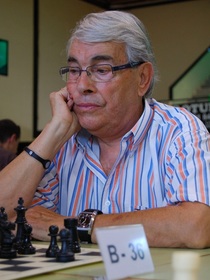 |
Maseda Iglesias, Luis (1787) - Andres Garcia, Vicente (1659) | 1-0 | Liga Madrileña 2010-2011 |
 |
06.03.2011 | [D04] Peon de Dama - Colle |
Maseda Iglesias, Luis (1787) - Alonso Cristobo, Luis (1927) | 0-1 | Liga Madrileña 2010-2011 | |
|
13.02.2011 | [D06] Gambito de dama |
 |
Maseda Iglesias, Luis (1787) - Ramos Orea, Tomas (1684) | 1-0 | Liga Madrileña 2010-2011 |
|
11.12.2010 | [D02] Peón de dama |
Maseda Iglesias, Luis (1787) - Mateu Mir, Gabriel (1621) | 1-0 | Festival de Benidorm - sub2000 | |
|
09.12.2010 | [D05] Colle - Zukertort |
 |
Maseda Iglesias, Luis (1787) - Aledo Yanguas, David (1428) | 1-0 | Festival de Benidorm - sub2000 |
|
06.12.2010 | [D06] Gambito de dama |
Maseda Iglesias, Luis (1787) - Vivanco Revuelta, Jesus Maria | 0-1 | Festival de Benidorm - sub2000 | |
|
25.11.2010 | [D05] Colle - Zukertort |
Maseda Iglesias, Luis (1787) - Lucia Carretero, Oscar (1668) | 1-0 | Madrid ch 2010/2011 Previa A | |
|
23.11.2010 | [D04] Colle - Zukertort |
 |
Maseda Iglesias, Luis (1787) - Rojas Pozo, Jose Luis (1946) | 0-1 | Madrid ch 2010/2011 Previa A |
 |
03.10.2010 | [D05] Colle - Zukertort |
Maseda Iglesias, Luis (1792) - Barajas Fernandez, Helios (1976) | ½-½ | 15. Torneo San Viator 2010 | |
|
24.09.2010 | [D05] Colle - Zukertort |
Maseda Iglesias, Luis (1792) - Tevar Becerra, Alvaro (1449) | 1-0 | 23. Open de Moratalaz 2010, 09/22/2010 | |
|
22.09.2010 | [D05] Colle - Zukertort |
Maseda Iglesias, Luis (1792) - Jauralde Pou, Juan J (1588) | ½-½ | 23. Open de Moratalaz 2010, 09/22/2010 | |
|
21.09.2010 | [D05] Colle - Zukertort |
Maseda Iglesias, Luis (1792) - Ballesteros Galvez, Daniel (1622) | 0-1 | 23. Open de Moratalaz 2010, 09/21/2010 | |
 1.d4 Cf6 2.c4 e6 3.Cc3 Ab4 4.Dc2 d5 5.a3

1.d4 Cf6 2.c4 e6 3.Cc3 Ab4 4.Dc2 d5 5.a3
1.d4 Cf6 2.c4 e6 3.Cc3 Ab4 4.Dc2 d5 5.a3
